Monday, September 24, 2012

Module 3: Jumanji


Bibliography:

Allsburg, C. V. (1981). Jumanji. Boston, MA: Houghton Mifflin Books for Children.


Book Summary:

One day brother and sister Peter and Judy find a board game, and decide to take it home with them. Once their parents are gone, Peter and Judy begin playing a game with very real consequences. Tormented by monkeys, being attacked by lions, and surviving a rhino stampede, this game sends Judy and Peter on a an amazing adventure.  Is all this really happening, or is it just a product of their imaginations? Read it, and you'll find out :)

My Thoughts:
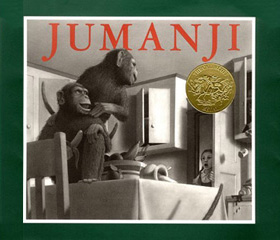
Growing up I saw the movie version of this book many, many times, but I never realized it was based on a book. Needless to say I felt a bit ridiculous for never reading the book version, because it was fantastic. The realistic quality of Van Allsburg's illustrations really enhance the story, bringing life to the words. I especially loved the monkeys, and was surprised to discover that the movie monkeys looked almost identical to the ones in the book.

Professional Reviews:

*Fantasy and reality merge, overlap and complement each other in Jumanji (81) by Chris van Allsburg. Peter and Jilly are bored and begin a boxed Jungle Adventure game but find themselves integrated with the creatures of the game itself. The illustrations are first class precise draughtsmanship with extraordinary imagery, presented as observation, as the house and jungle become intrinsically and fantastically linked.

(2012, December 12). "Picture books for older readers." [Review of the book Jumanji by Chris Van Allsburg]. School Librarian, 160.

*This Caldecott Award winning book has been intriguing people since it first came out. For those of you unfamiliar with the plot, it's the story of a bored brother and sister, left on their own for the afternoon, who find the board game, Jumanji, under a tree in the park. The instructions, on a note attached to the box, are firm: once started, the game must be played to the finish. When the children play the game, each adventure on the board brings the real creatures and events to life and into their home, creating danger and chaos. It isn't until Judy reaches Jumanji, the golden city at the end of the board, and yells the name that everything disappears, broken things are made whole and all is normal. The children put the game back where they found it, telling no one, only to watch children of friends of their parents who are known for not reading directions, take the game.

Hurst, C. (N.d.). [Review of the book Jumanji by Chris Van Allsburg]. Retrieved from http://www.carolhurst.com/titles/jumanji.html

Suggested Activities:
I think this book is perfect for a multiple part project rather than a single activity. Have children design their own board games that they will construct themselves. Also have them make up their own rules for their new game, then they can name it. The children will then play their games with each other!

Image Source:
 http://upload.wikimedia.org/wikipedia/en/a/ae/CM_jumanji.jpg


Tuesday, September 11, 2012

Module 3: So You Want to Be President?

Bibliography
St. George, J. (2005). So you want to be president?. (updated and rev. ed. ed.). New York: Putnam Juvenile

Book Summary:
Through entertaining illustrations and engaging text, So You Want to Be a President is packed full of presidential knowledge. Many interesting facts about our forty-two presidents are listed, including basic biographical and "fun" facts. Such as where the president resides and how old you have to be to run for president. Additional "fun" facts about the presidents are also mentioned such as what kind of pets they kept, how many were born in log cabins, and even how many had the same name. Packed full of interesting knowledge, So You Want to Be a President helps us to get to know our presidents a little better.

My Thoughts:
I can honestly say that I thoroughly enjoyed both the illustrations, and the facts as well. It wasn't until picking up the book that I realized that I knew practically nothing about our presidents. The facts were really interesting, and I appreciated that there were some lesser known personal stories as well. Most importantly though, the illustrations were eye catching and helped enhance the facts and tales I was learning about.
Professional Reviews:

*Sometimes you can judge a book by its cover--and this is one of those times. David Small has cleverly depicted the presidential faces on Mount Rushmore in a jovial cartoon style that makes them friendly and not formidable, an encouraging invitation to the witty observations within a narrative that felicitously begins, "There are good things about being President and there are bad things about being President." Arranging historical tidbits in an attractive buffet, this well-timed book offers anecdotes both cautionary and guaranteed to attract attention and arouse interest. Would-be presidents are apprised of the advantages of the position, which include having a swimming pool, bowling alley, and movie theater as well as never eating "yucky" vegetables--like broccoli. As a counterpoint to the advantages, a few negatives are also presented: presidents have to dress up, be polite, and never "go anywhere alone," and they have quantities of homework. Having examined both sides of the question, succeeding spreads offer tips for achieving the desired goal: having the right first name (six presidents were named James, four John, four William, two George, two Andrew, and two Franklin); having siblings; being born in a log cabin; joining the army; becoming a hero; being a vice-president. The question of appearance is treated as a quasibeauty contest featuring Warren Harding, who was handsome--but not a good president, as even he admitted. The overall tone is upbeat, and the need for honesty in office is stressed by contrasting Truman and Cleveland with Nixon and Clinton, the latter two depicted descending, as in banishment, the steps of the Lincoln Memorial--a sad visual commentary. The conclusion, with its reiteration of the oath of office, is positively inspiring. Appended are a list of personages featured in the illustrations, brief biographical sketches of the presidents in chronological order, and a short bibliography.

Burns, M. M. (2000). [Review of the book So you want to be president by Judith St. George]. Horn Book Magazine76(4), 476-477
*Curious tidbits of personal information and national history combine with humorously drawn caricatures to give this tongue-in-cheek picture book a quirky appeal. "There are good things about being President and there are bad things about being President." So begins a walk through a brief history of facts, successes, oddities, and mishaps. For example, most readers won't know that William Howard Taft weighed over 300 pounds and ordered a specially made bathtub. Small's drawing of a naked Taft being lowered into a water-filled tub by means of a crane should help them remember. Another spread depicts a men's shop where Andrew Johnson (a tailor) fits Ronald Reagan (an actor) for a suit while Harry Truman (a haberdasher) stands behind the counter. While the text exposes the human side of the individuals, the office of the presidency is ultimately treated with respect and dignity. A list ofpresidents with terms of office, birthplace, date of birth and death, and a one-sentence summary of their accomplishments is provided. This title will add spark to any study of this popular subject.

Eames, A. (2000). [Review of the book So you want to be president by Judith St. George]. School Library Journal46(8), 206-207.

Suggested Activities:
Activities for this book can be about the hats of iconic presidents, such as the stove pipe hat of Abraham Lincoln, or the three cornered hat of George Washington. Perfect for use in an election year.


Image link:
 http://www.google.com/imgres?q=so+you+want+to+be+president&hl=en&client=safari&sa=X&rls=en&biw=1259&bih=598&tbm=isch&prmd=imvnsb&tbnid=4voJ4goP2f456M:&imgrefurl=http://www.booksofwonder.com/prodinfo.asp%3Fnumber%3D131213&docid=mM0tjzjNI9WvWM&imgurl=http://www.booksofwonder.com/images/131213.dd.gif&w=432&h=432&ei=xzNZUOXiK6S6yAH9oIDADA&zoom=1&iact=hc&vpx=566&vpy=262&dur=1129&hovh=225&hovw=225&tx=87&ty=240&sig=112010997568663287599&page=1&tbnh=124&tbnw=124&start=0&ndsp=14&ved=1t:429,r:10,s:0,i:126

Sunday, September 9, 2012

Module 2: The Celery Stalks at Midnight

Bibliography:
Howe, J. (1983). The celery stalks at midnight. New York, NY: Macmillan Publishing Company. 

Book Summary:
http://images.betterworldbooks.com/038/The-Celery-Stalks-at-Midnight-9780380690541.jpgIn this hilarious chapter of Bunnicula series, Chester the cat, Howie the puppy, and Harold the dog team up to fight an army of zombie vegetables. Bunnicula the veggie vampire rabbit is missing again, so gang fears that the victims are part of a zombie army. The animals try to keep the vegetable zombie army from taking over town and  arm themselves with toothpick. They encounter suspicious, strange clues that point towards vampire slaves. I won't ruin the ending for you, so pick it up and read the third installment in the Bunnicula series.

My Thoughts:
I remember reading Bunnicula when I was younger, but for some reason or another I never picked up another book in the series. After reading The Celery Stalks at Midnight, I found myself wishing that I had read it sooner. Books in which animals are the main characters are among my favorites, probably because I appreciate the thought that a cat and two dogs can talk to each other. I think this book would be great to use in the fall, closer to Halloween so that kids can enjoy a funny zombie story rather than a scary one.

Professional Reviews:

*"When readers hear about dead beets, killer parsnips and homicidal heads of lettuce lurking in the neighborhood, they won't think it's a vegetable war—they'll know that Bunnicula, the vampire(?) rabbit has returned. . . . The amusing and skillful black-and-white sketches capture the animals' antics and expressions of alternating doubt, skepticism, disgust and worry in this clever tale abounding with puns, wild chases and slapstick humor. Bunnicula (1979) fans will be delighted to rejoin cynical Chester, Howie, a dachshund puppy and the canine narrator Harold, who, at the end, becomes apprehensive for even he admits he hears the thump thump thump of an artichoke heart."

Jones, T. (1983). [Review of the book The celery stalks at midnight by James Howe]. School Library Journal30124.

*"The sequel to Bunnicula and Howliday Inn is another startling tongue-in-cheek exposé. Composed in a light-hearted, lively style, the narrative moves briskly from one outrageous pun to another—a technique guaranteed to win the hearts of humorists as they follow the exploits of Chester, the cat, while he tries to defend his territory from a danger only he is astute enough to recognize—or so he thinks. . . . With his two canine companions—Harold, the narrator, and Howie, a naive dachshund—Chester sets forth to locate Bunnicula and to save the victims. Their route is marked by mishaps, misunderstandings, and misadventures as the trio incursthe wrath of a coddled feline, tours the town dump, and invades the school carnival. Kaleidoscopic action, broad comedy, and appealing format suggest the book as an answer to the need for well-crafted escapist reading."

Burns, M. M. (1983). [Review of the book The celery stalks at midnight by James Howe]Horn Book Magazine59709.

Suggested Activities:
This book would be perfect for a zombie themed activity for Halloween. A flannel board with the main characters and a white veggie zombie army could be used to help tell the story.

Image link:
 http://images.betterworldbooks.com/038/The-Celery-Stalks-at-Midnight-9780380690541.jpg