Saturday, November 17, 2012

Module 6: The Stinky Cheese Man and Other Fairly Stupid Tales


Bibliography:
     Scieszka, J. (1992). The stinky cheese man and other fairly stupid tales. New York, NY: VikingBooks.

Book Summary:
This fabulous book revisits many traditional fairy tales, but gives them an interesting new twist. These "fairy stupid tales" are hilarious re-tellings including "The Stinky Cheese Man," "Chicken Licken," and "The Really Ugly Duckling." The book is narrated by Jack (of beanstalk fame) who makes starts making jokes beginning with the title page. Each story has new comedic characters, and the Red Hen occasionally stops in to give her two cents worth. Overall, this books is a great read for anyone who wonders how fairy tales REALLY happened.

My Thoughts:
I thoroughly enjoyed this book, especially the little side jokes that I think were meant more for adults than children. It's hard to pick a favorite retelling, because each and every one of them is hilarious, and puts a new twist on an old classic. I think that this book would be a great way to get boys to read fairy tales, because they are a little more gross and twisted than the traditional versions.
 
Professional Reviews:

*Grade-school irreverence abounds in this compendium of (extremely brief) fractured fairy tales, which might well be subtitled ``All Things Gross and Giddy.'' With a relentless application of the sarcasm that tickled readers of The True Story of the Three Little Pigs , Scieszka and Smith skewer a host of juvenile favorites: Little Red Running Shorts beats the wolf to grandmother's house; the Really Ugly Duckling matures into a Really Ugly Duck; Cinderumpelstiltskin is ``a girl who really blew it.'' Text and art work together for maximum comic impact--varying styles and sizes of type add to the illustrations' chaos, as when Chicken Licken discovers that the Table of Contents, and not the sky, is falling. Smith's art, in fact, expands upon his previous waggery to include increased interplay between characters, and even more of his intricate detail work. The collaborators' hijinks are evident in every aspect of the book, from endpapers to copyright notice. However, the zaniness and deadpan delivery that have distinguished their previous work may strike some as overdone here. This book's tone is often frenzied; its rather specialized humor, delivered with the rapid-fire pacing of a string of one-liners, at times seems almost mean-spirited. Ages 5-up

(1992, September 28). [Review of the book The stinky cheese man and other fairly stupid tales by Jon Scieszka]. Publisher's Weekly. Retrieved from http://www.publishersweekly.com/978-0-670-84487-6

*Whatever Jon Scieszka and Lane Smith coproduce usually spells a raucous time for everyone, and this book's no different. It's a continuation of the fairy tale fracturing the pair undertook in The True Story of the Three Little Pigs {BRD 1990}, going that story nine better. . . . The Stinky Cheese Man isn't a book for little ones. It will take older children . . . to follow the disordered story lines and appreciate the narrative's dry wit, wordplay, and wacky, sophomoric jokes. . . . Every part of the book bears the loving, goofy stamp of its creators, and while their humor won't appeal to everyone, their endeavors will still attract a hefty following of readers—from 9 to 99.

Zvirin, S. (1992).[Review of the book The stinky cheese man and other fairly stupid tales by Jon Scieszka]Booklist8956.

Suggested Activities:
I think that the perfect activity for this book would be to have the children write their own versions of classic fairy tales, complete with illustrations. The stories would then be collected and bound and kept for everyone to read! Or, I could turn it into an ebook. 

Image Source:
http://upload.wikimedia.org/wikipedia/en/thumb/4/45/The_Stinky_Cheese_Man_Book_Cover.jpg/200px-The_Stinky_Cheese_Man_Book_Cover.jpg

Tuesday, October 2, 2012

Book Trailers

Tangerine by Edward Bloor This video was made using images courtesy of Jupiter Images, and Stupeflix video maker

3 Willows by Ann Brashares Image copyrights by Flickr members: Moyan Brenn, Valentin.Ottone's, Memekiller, Rennett Stowe, newagecrap, David Sedlmayer, Tracheotomy Bob, and juicyverve. Book cover courtesy of: Delacorte Press

The Phantom Tollbooth by Norton Juster Image copyrights by Flickr members: John-Morgan, jinterwas, Matt From London, Dave Stokes, wablair, twitchcraft, hudsonthego, theinvisiblewombat. Book cover courtesy of Bullseye Books.

Monday, October 1, 2012

Module 5: Snapshots from the Wedding

Bibliography:
Soto, G. (1997). Snapshots from the wedding. New York, NY: G.P.    
     Putnam's Sons.


Snapshots-from-the-Wedding-Soto-Gary-9780613121170.jpgBook Summary:
This story is told from the perspective of Maya, who is the flower girl for Isabel at her wedding. Maya describes the day to us in interesting detail, introducing us to the ring bearer, the bride, her aunt, and many other family members. She has so much fun listening to the Marachi band, dancing on her fathers shoes, and decides to wear olives on her fingers. She even ends up with mole all over her face. She truly had a day to remember.


My Thoughts:

I was really wowed by the artwork for this book. Stephanie Garcia truly captured the moments described by author Gary Soto. I also really liked that there were some Spanish terms sprinkled in the text, making it more of a Spanglish type story. This story rich in Latin American culture is a treat for readers of all ages! 
 

Professional Reviews:

*From Soto (Off and Running, 1996, etc.), a celebratory, child's-eye look at a wedding that captures the traditional mingling of the surreal and the sublime. A flower girl, Maya, tells in a pitch-perfect accent about the groom, Rafael, who is at the altar with his arm in a cast (he slid into home playing softball and scored, but broke his wrist), and a host of other relatives and strangers. Crying babies, the altar boy's dirty sneakers, an inconvenient sneeze, and the glow in the bride Isabel's eyes are reported with equal fervor. At the reception, Maya puts a pitted olive on each finger, finds mole sauce on her gown, and dances, riding on her father's feet. While the family is Mexican-American, the wedding's touching and silly moments are universal. Garcia's illustrations, photographs of Sculpy clay figures and collage, are pink and white and delicious, reminiscent of both reredos and scenes from a dollhouse. With all the problem books in the world, it's a delight to encounter one that talks about a happy event and its attendant joys. This is a triumph of true-to-life storytelling, with all the good parts left in.

(1997, March 17). [Review of the book Snapshots from the wedding by Gary Soto]. Kirkus Review. Retrieved from http://www.kirkusreviews.com/book-reviews/gary-soto/snapshots-from-the-wedding/

*Photographs of shadowboxes filled with sculpted clay figures form the eye-catching art for Soto's ""diary"" of Maya, a flower girl. The text, sprinkled with Spanish words, is eloquent and funny (a bride's hands are ""soft as doves""; a cousin wiggles his tongue ""in the space between his baby teeth, white as Chiclets"")-and it deftly captures the flavor of a Latino wedding, complete with mariachi band. Garcia's singular, deliciously creative artwork steals the show here, however. More playful than the dioramas she composed for The Old Lady and the Birds, these lifelike, three-dimensional scenes serve as an elaborate stage set. Readers will be enthralled by Garcia's use of details, from the "actors" and "actresses" decked out in wedding finery to the garlanded ribbons festooned across the shadowboxes to the objects that enhance each scene (tiny silk flowers in the bride's bouquet; potato chips on the buffet table). Using Soto's words as a springboard, Garcia tweaks the perspective, offering a legs-and-feet-only view, for instance, of a scene in which Maya describes the younger wedding guests' ""shoes off"" romp down the hallway (complete with authentically dusty soles of socks). Another ""snapshot"" shows a pair of sculpted hands holding a plate with a flower-topped slice of wedding cake. A happy marriage of talents. Ages 4-8. 

(1997, March 03).[Review of the book Snapshots from the wedding    

     by Gary Soto]Publishers Weekly. Retrieved from http://www.publishersweekly.com/978-0-399-22808-7

Suggested Activities:
Have children make a diorama of a favorite family memory. We would then make a display for the dioramas in library. 

Image Source:
http://images.betterworldbooks.com/061/Snapshots-from-the-Wedding-Soto-Gary-9780613121170.jpg

Saturday, September 29, 2012

Module 5: Zora and Me


Bibliography
Bond, V., & Simon, T. R. (2010). Zora and me. Somerville, MA.: Candlewick.

     
imgres.jpg
Book Summary:
Zora and Carrie live in the little town of Eatonville, where they spend their time with their friend Teddy, and frequently go swimming in the Blue Sink (what they call their local swimming hole). Zora and Carrie witness an alligator attack and rescue a local elderly woman from drowning, but Zora is very suspicious of the accidents. The girls try to figure out if a local man is really half alligator, and after a migrant worker is found headless on the train tracks, Zora and Carrie decided to figure out what is really going on in their sleepy little town.

My Thoughts:

I really couldn't put this book down. I love a good murder mystery, and this fictionalization of the early life of Zora Neale Hurston definitely delivered. I was also surprised to learn that this book is a fictional version of the early life of literary figure Zora Neale Hurston. Overall, a great read--it's easy for me to see why it was selected for a Coretta Scott King award!

Professional Reviews:

*The childhood of African-American literary giant Zora Neale Hurston is brought to life with this fictionalized account. At the turn of the 20th century, in the all-black town of Eatonville, Fla., Young Zora is considered both a brilliant storyteller and the town liar. Her best friend, Carrie, the "me" of the title, is drawn into Zora’s family and story world after her father leaves for work and never returns home. Zora’s stories about a shape-shifting alligator take on a life of their own when two murders occur around Eatonville. The suspect is a reclusive neighbor, Mr. Pendir, whom Zora is convinced is the “gator man.” Yet the answer is much more prosaic, as the segregated world outside Eatonville encroaches upon their town in the form of traveling man Ivory and the preternaturally beautiful yet mysterious Gold. The brilliance of this novel is its rendering of African-American child life during the Jim Crow era as a time of wonder and imagination, while also attending to its harsh realities. Absolutely outstanding. 

(2010, September 15). [Review of the book Zora and me by Victoria   
     Bond and T.R. Simon]. Kirkus Review. Retrieved from http://www.kirkusreviews.com/book-reviews/victoria-bond/zora-and-me/

*Excerpt of review: Where is the black version of Caddie Woodlawn (a 19th-century Wisconsin tomboy) or Harriet the Spy (a 20th-century Upper East Sider), smart, spunky, fictional heroines for the tween crowd? Tanya Simon, a literary agent, asked herself that question while pregnant with her daughter, now 4. She answered by reaching back in time to Zora Neale Hurston, a canonical Harlem Renaissance writer, and imagining her as a girl detective. Ms. Simon and her close friend Victoria Bond put flesh on that idea with “Zora and Me,” an evocative mystery published last month by Candlewick Press. 

Lee, F. (2010, November 2). Revered Writer Becomes Girl Detective       
     [Review of the book Zora and me by Victoria Bond and T.R. 
     Simon]. New York Times. Retrieved from http://www.nytimes.com/2010/11/02/books/02zora.html

Suggested Activities:
Have children make up their own tall tales, complete with illustrations. I would like to then make an e-book copy of the tales and make them available to the children and their parents.

Image Source:
http://www.candlewick.com/images/cwp_bookjackets/648/0763658146.jpg

Monday, September 24, 2012

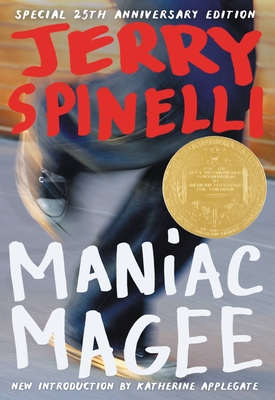
Module 4: Maniac Magee


Bibliography

Spinelli, J. (1990). Maniac Magee. Boston, MA: Little, Brown and Company.


Book Summary:

Jeffrey Magee is better known to the kids of Two Mills as the legendary Maniac Magee. Tales of his feats have been greatly exaggerated over time, making him a celebrity on both sides of town. Truthfully, Maniac was an orphan, living on his own on the streets.  Living with multiple families on both sides of his racially divided town, Maniac runs back and forth between the two, trying to find a place where he belongs.

My Thoughts:
This has always been one of my favorite books, but once again, reading it as an adult really changed my perspective of it. This time, I was struck by the conditions in which Manic Magee lived, and how he barely survived all by himself on the streets. The way he conquered racism is admirable, and a lesson children and adults can take to heart. I would recommend this book in a heart beat!


Professional Reviews:

*An occasionally long-winded, but always affecting, parable-like story about racism and ignorance. Jeffrey Magee is twice homeless--once involuntarily, at age three, when his parents plunge with a high-speed trolley off a bridge; the second time eight years later, when he voluntarily leaves the troubled home of his aunt and uncle. Jeffrey's subsequent yearlong flight generates a host of legends:, his sudden appearances and astonishing athletic prowess earn him the name "Maniac," and his just-as-sudden disappearances ensure his fame. Innocently, he crosses between two strictly segregated parts of town, the white East End and the black West End, making friends and enemies in both camps and managing to soften the lines of segregation; later, he finds a new home in the West. If this is sometimes a bit like a chalkboard lesson, it may be because racism is still a volatile subject that is more comfortably dealt with in parable form. The metaphorical style is a brave change from the realism of Spinelli's other books, while fans of his earlier, tongue-in-cheek, streetwise tone will find it also an integral part of this story--ballast for the mythic, shifting picture of Maniac's year on the run. 

(1990, March 15). [Review of the book Maniac Magee by Jerry Spinelli]. Kirkus Review. Retrieved from http://www.kirkusreviews.com/book-reviews/jerry-spinelli/maniac-magee/

*Maniac Magee is prose on a pogo stick, bounding breathlessly from one outrageously exaggerated comic contretemps to another. The characters are engaging and the dialogue zings with slangy bravado. But when Spinelli gets serious, the plot turns to mush. Maniac is just too sweet and good, even for a legend. His tender relationship with an illiterate old baseball player verges on the embarrassing. And no kid who reads this book is going to believe that racism can be conquered so easily and sentimentally. Still, energy and good- heartedness make this novel — most of the time — an exhilarating read. B+.

Landsberg, M. (2012, August 29).  [Review of the book Maniac Magee by Jerry Spinelli]. Entertainment Weekly. Retrieved from http://www.ew.com/ew/article/0,,313147,00.html


Suggested Activities:
This book could be used in a variety of settings, such as a book club or a middle school. A whole unit would be done on the book-analyzing how far the truth had been stretched, the methods Maniac used to teach Grayson to read, and even a knot untying contest.


Image link:
http://blog.schoollibraryjournal.com/afuse8production/files/2012/05/ManiacMagee5.jpg

Module 4: Island of the Blue Dolphins


Bibliography

O'Dell, S. (1960). Island of the blue dolphins. Boston, MA: Houghton Mifflin Books for Children.


Book Summary:

This book is based on the real life story of a Native American woman who lived in the 1880's. When white men come to the island to take it's inhabitants back to civilization, Karana is left behind when she jumps off the ship to stay with  her little brother, Ramo, who went back for a spear and missed hte ship in the process. Shortly after returning to the empty village, Ramo is killed by wild dogs. Forced to survive on her own, Karana struggles with the isolation of her existence. Will the white men come back for her, or will she be there alone for the rest of her life? Read the book and find out :)

My Thoughts:
I originally read this book when I was in intermediate school, and for some reason or another, I never realized that Karana was twenty-four years old when the story began. Knowing she was so close to my own age really put this book in perspective. I was totally in awe of her will to survive despite her isolation on the island. The heartbreak I felt when Ramo died really hit home with me this time, even though I knew from my previous experience with the book. I would definitely recommend that adults pick this one back up, or encourage your child to read it with you, it is a great story of survival!

Professional Reviews:

*Take TV's Survivor and Fear Factor, Hollywood's Cast Away, and the books Robinson Caruso and Call of the Wild...wrap them all together... make them SO MUCH better (in my opinion!) and what do you have? The classic book by Scott O'Dell, Island of the Blue Dolphins.

Ratha, M. (2009, July 2). [Review of the book Island of the Blue Dolphins by Scott O'Dell]. Ink Splot 26 Blog. Retrieved from http://blog.scholastic.com/ink_splot_26/2009/07/book-review-island-of-the-blue-dolphins.html

*This is the story of Karana, the indian girl who was stranded on an island known as the Island of Blue Dolphins with her brother Ramo. After a few months, Ramo died, leaving behind Karana all by herself. Year after year, she waited for a ship to come and take her away. While she waited, she built shelters, made weapons and hunt for food to keep herself alive. She also managed to make friends with some island animals. This story is not only adventurous but also a tale of self-discovery.

Zahn, R. (N.d.). [Review of the book Island of the Blue Dolphins by Scott O'Dell]. Retrieved from http://www.allreaders.com/topics/Info_25513.asp

Suggested Activities:
I would love to use this book in a middle school setting to have students discuss isolation and survival in the wilderness. Building on this theme, we would also read other books on survival, such as Hatchet by Gary Paulsen, and compare and contrast the situations and characters of the two books.

Image link:
http://www.google.com/imgres?hl=en&client=firefox-a&hs=4Ua&sa=X&rls=org.mozilla:en-US:official&biw=1573&bih=706&tbm=isch&prmd=imvnsb&tbnid=SiP-93iFfFqxCM:&imgrefurl=http://blog.schoollibraryjournal.com/afuse8production/2012/05/28/top-100-childrens-novels-45-island-of-the-blue-dolphins-by-scott-odell/&docid=aSXgpJrrJF02NM&imgurl=http://blog.schoollibraryjournal.com/afuse8production/files/2012/05/IslandBlueDolphins.jpg&w=268&h=400&ei=1rdgUP3BLaWC2wWf8YHYCg&zoom=1&iact=hc&vpx=327&vpy=251&dur=2075&hovh=274&hovw=184&tx=91&ty=157&sig=108315845861219599235&page=1&tbnh=114&tbnw=72&start=0&ndsp=32&ved=1t:429,r:11,s:0,i:180